Heritage trail · Whaaingaroa
Raglan Town Walk
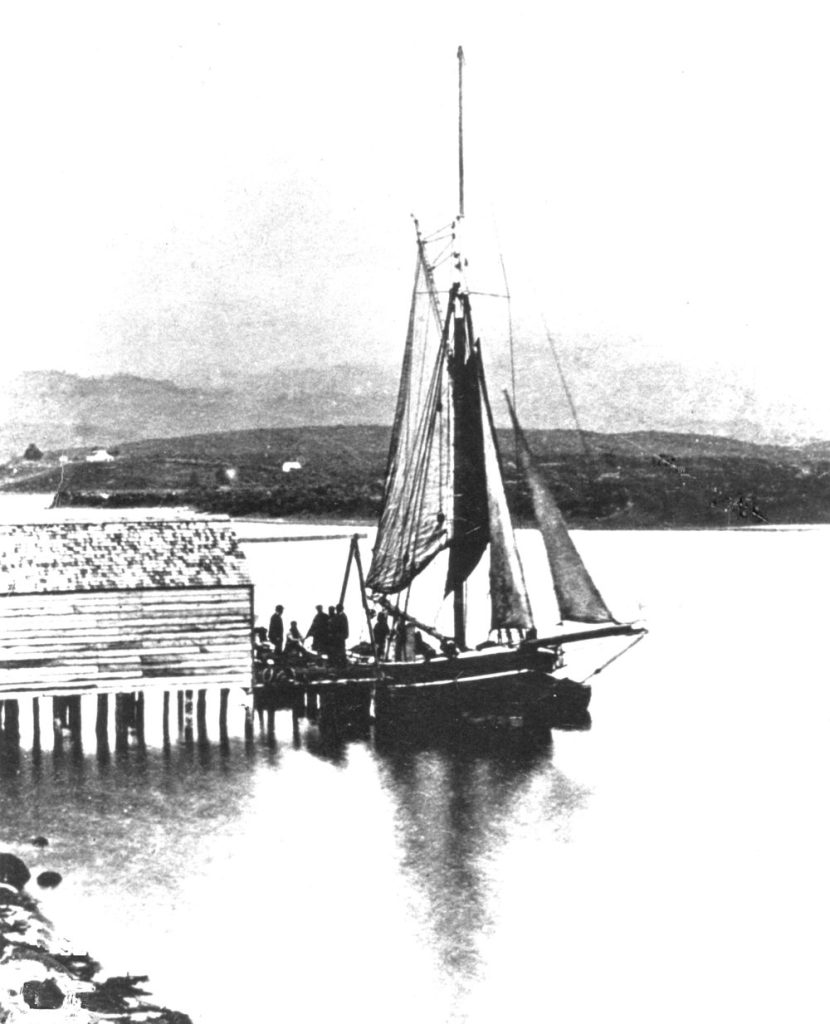
A 20-minute loop around Bow Street, Wainui Road and Stewart Street – from the harbour where the first jetty stood in 1874 to the art deco Town Hall.
- Time
- About 20 min
- A loop on footpaths in town
- Start
- 5 Bow St
- Corner of Wi Neera St, by the harbour
- Stops
- 16
- Bow St, Wainui Rd and Stewart St
- History signs
- 6 stops
- Part of the Signs Walk
- Heritage NZ
- 3 registered sites
- Redoubt and cottage, Old School, Harbour View Hotel
The stops
Stops with a flax ring have a history sign with photos.
-
5 Bow St, corner of Wi Neera St
Stop 1: Smiths Supply Stores
Smiths Supply Stores built this building about 1900. Farmers Trading Co. were here from 1920 to 1950, and general stores ran on the site until 1969.
Around the corner: Wi Neera Street. Formerly Nero St, a misspelling of Neera, the street is named after Wiremu Neera (William Naylor) Te Awa-i-taia, a fierce and influential Maaori warrior chief. One of Rev. James Wallis’ first converts to Christianity, Te Awa-i-taia was also a signatory to the Treaty of Waitangi, and had a meeting house in this street. A redoubt was built here, with the blockhouse used as a courthouse and lock-up. Te Awa-i-taia ensured no fighting occurred in Whaaingaroa during the NZ land wars. Just down the street is the 1893 Courthouse cottage at 1 Wi Neera St.
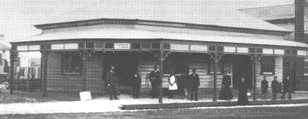
Smith’s store, 1910 -
1 Bow St
Stop 2: Immigrant kauri cottage
-
Harbour end of Bow St
Stop 3: Wallis Memorial
-
Foreshore opposite Bow St
Stop 4: The first jetty
-
7 Wainui Rd
Stop 5: The old Anglican church
Another 1874 prefabricated immigrant cottage, built on this site in 1877. It was the Anglican church from 1877 until 1922, then the parish hall until 1952. It was also the secondary school in 1935, and later local kuia Eva Rickard’s Waka Huia (treasure chest), the forerunner of the Whaaingaroa Trade Aid shop.
From 1989 to 2017 it was a restaurant, first Vinnies – Raglan’s first contemporary restaurant – when the upper floor and front room were added.
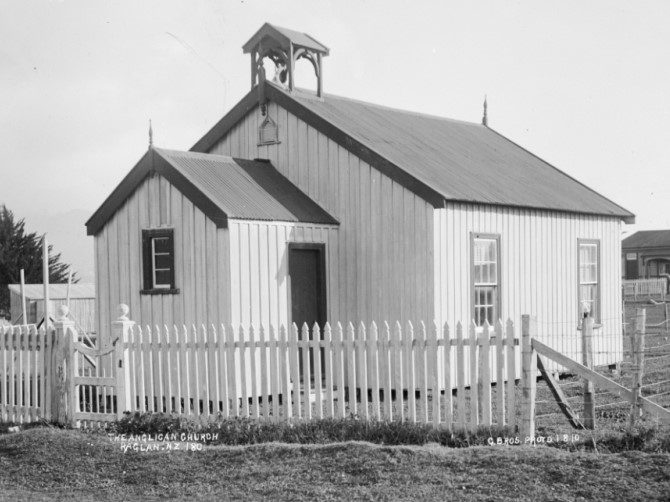
The oldest building in Raglan: the old Anglican church -
Wainui Rd, opposite Stewart St
Stop 6: Raglan & District Museum
-
Corner of Wainui Rd and Stewart St
Stop 7: Union Church
-
Stewart St
Stop 8: The Old School
Built in 1883 and used as the Raglan primary school until 1962, then as the county depot. It is now the Raglan Old School Arts Centre.
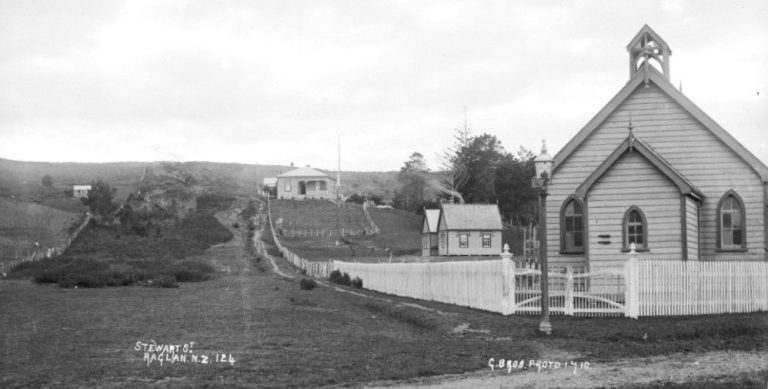
Stewart St, 1910: church, school and head teacher’s house -
44 Bow St, corner of James St
Stop 9: St Peter’s Anglican Church
St Peter’s opened in 1925, built on land donated by Dr Sanders. The church cost £1000 and its furnishings £300.
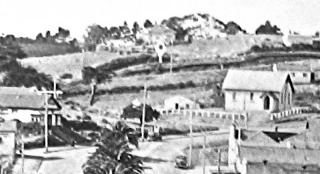
Bow St in 1939, with the Anglican church centre right -
32 Bow St
Stop 10: The Chronicle building
-
Bow St
Stop 11: Raglan Town Hall
-
19 Bow St, corner of Wainui Rd
Stop 12: Dando’s building
Land agent Sydney Dando built this building in 1902. It became Langley’s Auction Mart & Bookstore, then later a billiard saloon.
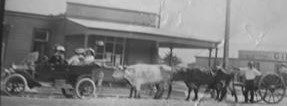
John Galvan’s bullock team outside 19 Bow St, 1910 -
14 Bow St
Stop 13: Harbour View Hotel
-
17 Bow St
Stop 14: Gilmours’ building
-
Bow St centre median strip
Stop 15: War Memorial, poohutukawa and phoenix palms
The memorial was unveiled in 1922 by Lady Jellicoe, who commented how beautiful the temporary pongas were. At its next meeting the Town Board approved planting palms and poohutukawa trees in Bow St.
In the 1960s the Raglan County Council began cutting the trees down. Local baker Connie Stephens chained herself to the trees at the harbour end of Bow St and stopped the removal of the remaining poohutukawa.
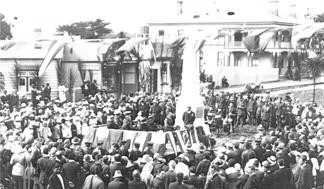
Unveiling the War Memorial, 1922 -
2 Bow St
Stop 16: Bernard’s bakery